
CirculYOUNG was created to help young people who are not in education, employment or training (NEETs), including many from migrant backgrounds, take part in the green transition. One of its main results is a free online course on the circular economy. It is designed for young learners, and also for the educators, youth workers and trainers who support them. In this post we look at what the course offers and how you can reuse its resources in your own work.
Three learning modules
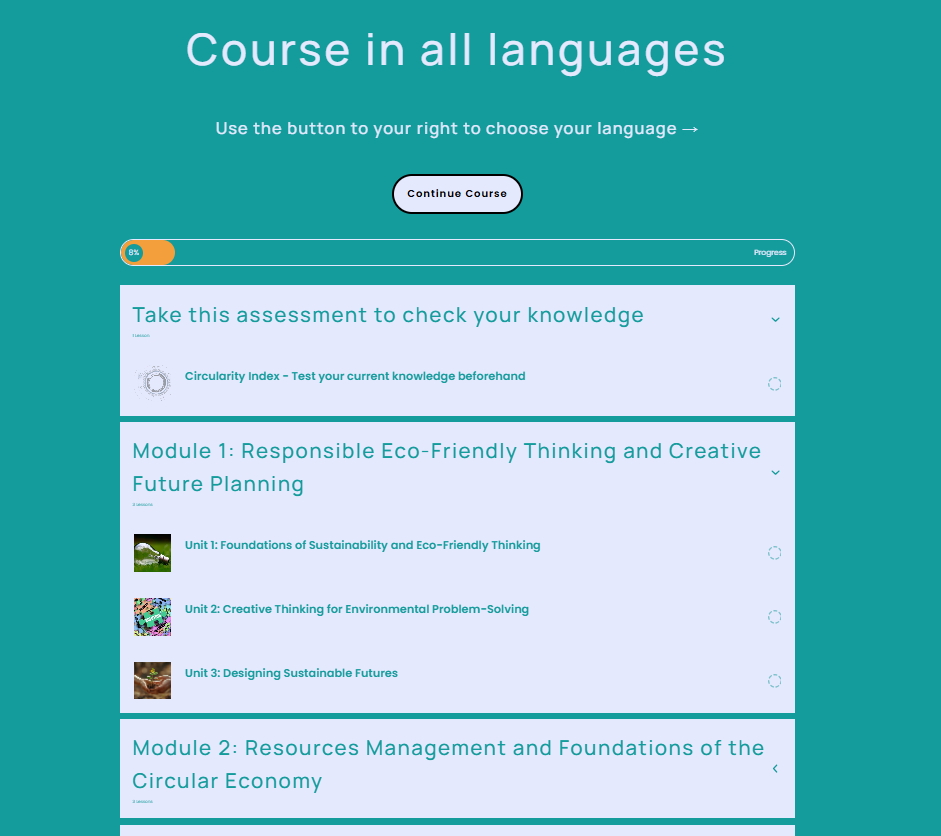
The course has three modules, each with three short units. Every unit mixes short texts, videos, real case studies and quick activities, and ends with a quiz.
-
what sustainability means, how to think creatively about the environment, and how to design solutions for a more sustainable future.
-
managing resources, understanding the circular economy and reducing waste in everyday life.
-
skills for the workplace, the value of mentoring, and how sustainable habits fit into workplace culture.
The path goes from "what is it?" to "what can I do?" and finally to "how can this help me find a job?"
Start the path today!
← click hereLearning from real stories
The course uses examples that young people can recognise. Learners meet KOURI, a circular fashion case, and look at how companies such as IKEA and Patagonia, with its Worn Wear programme, keep products in use for longer.
In Module 3 they follow stories closer to their own lives: a green start-up founded by migrants in Vienna, and Sofia, a young migrant in Athens who finds a mentor in an upcycling workshop.
Activities that work beyond the screen
Many activities can be done online, alone or in a group. Others are perfect for a classroom or a youth centre. Learners can choose a one-week challenge, from repairing and swapping clothes to saving energy or eating local food. They can sort everyday objects into the 9 Rs of the circular economy, from Refuse to Recycle. They can also work in teams to invent a solution for a problem in their neighbourhood and build a model with recycled materials.
start where you are
〰️
start where you are 〰️
Start where you are: the Circular Behavioural Index
The course works together with the Circular Behaviour Index, a short self-assessment of everyday habits. The Index was first developed in the CLAY project, and CirculYOUNG adapted it for migrants and NEET youth. Learners take it at the start and at the end of their training. Their score, from 0 to 100, suggests where to begin:
Beginner (0–50 points): start with Module 1, to build ecological awareness and creative thinking.
Intermediate (51–80 points): start with Module 2, to improve resource management and practical circular skills.
Advanced (81–100 points): go to Module 3, to apply circular habits at work and in mentoring.
Click here to check the https://www.circulyoung.eu/english-course/tot-khexa
Resources for educators
The course is part of a small set of open resources that you can use and adapt with your groups:
The course is part of a small set of open resources that you can use and adapt with your groups:
The CirculYOUNG Roadmap: a guide for educators with research on circular economy awareness in the partner countries, how to use the Circular Behaviour Index, and the training methodology.
The Bootcamp Guidelines: a step-by-step guide to organising a local CirculYOUNG bootcamp, based on the bootcamps held in Austria, Ireland, Greece and Italy.
You do not need to use everything. A single unit, a case study or one activity can be enough to start a conversation about the circular economy with your group.If you are a youth educators or trainer we encourage you to explore
each CirculYOUNG results and use it in your next workshop or
recommend it to the young people you work with.
If you use CirculYOUNG materials, we would love to hear how it went!