
Module 1: Responsible Eco-Friendly Thinking and Creative Future Planning
CirculYOUNG
-
CirculYOUNG -
LEARNING OUTCOMES
-
1.1.K1.
Understand the principles of future-oriented planning for sustainability -
1.1.S1.
Apply appropriate tools and methods to develop sustainable and innovative designs -
1.1.RA1.
Advocate for sustainable design projects with a future-focused mindset
IN THIS LESSON, you will learn about the fundamental problems of our current economic system
UNIT 3.1– Designing Sustainable Futures
Welcome! In this video, you’ll explore the fascinating world of biomimicry—where people look to nature’s incredible designs and strategies to solve human challenges in sustainable ways. Biomimicry is about learning from Earth’s billions of years of innovation to create products, systems, and businesses that work in harmony with the environment. You’ll meet inspiring innovators who apply nature’s wisdom to build a healthier planet, showing how creativity and sustainability go hand in hand when designing our future.
1. VIDEO
“Biomimicry is innovation inspired by nature. In a society accustomed to dominating or 'improving' nature, this respectful imitation is a radically new approach, a revolution really.”
— Janine M. Benyus
2. INTRODUCTION
In this unit, you’ll explore practical approaches to developing sustainable and innovative designs in entrepreneurship. We’ll focus on tools and strategies like Circular Business Models, Cradle-to-Cradle design, Closed-Loop Supply Chains, and Industrial Symbiosis. You’ll learn how to build businesses that create lasting value while protecting the environment, all with a future-focused mindset that drives long-term success.
2.1 What is Circularity and Sustainability: Two Connected but Distinct Path?
-
Introduced by professor John T. Lyle in the 1970s, regenerative design envisions systems that replenish themselves by cycling their own energy and materials. It aims to meet societal needs within nature’s limits, going beyond sustainability by actively restoring ecological balance.
More information on the Regenerative Design website.
-
This approach looks at industrial systems through an ecological lens. It focuses on how energy and materials move through production cycles, aiming to mimic natural ecosystems where one process’s waste becomes another’s input.
More information on the Journal of Industrial Ecology website.
-
Instead of relying on fossil fuels, a bio-based economy uses renewable biomass—like plants, algae, and organic waste—as a source for materials and energy. It emphasizes sustainable, non-food uses of biological resources.
More information on the Biobased Economy-website.
-
Defined by the United Nations Environment Programme (UNEP), a green economy supports human well-being and social equity while significantly lowering environmental risks and resource scarcity. It integrates environmental goals with inclusive economic growth.
More information on the UNEP Green Economy website.
-
Swiss thinker Walter Stahel introduced the idea of a circular economy built on extending product life, repairing goods, and reducing waste. His concept of the “performance economy” shifts the focus from ownership to access—people pay for using a product rather than buying it outright
More information in the article of Stahel (2010)
-
Created by economist Kate Raworth, this model offers a new way to measure progress. It combines social foundations (like food, education, and equality) with ecological ceilings (such as climate limits and biodiversity), aiming to keep human development within a "safe and just" space.
More information on the Doughnut economy-website.
-
Developed by Michael Braungart, this framework reimagines product design so that materials can either safely return to nature or be fully reused in new manufacturing cycles. It focuses on eliminating harmful substances and designing with the product's entire life cycle in mind
More information on theCradle-to-Cradle website.
While circularity plays a key role in building a more sustainable future, not all sustainability efforts are circular by nature. Circularity centers on the continuous flow and reuse of resources, aiming to eliminate waste through closed-loop systems. Sustainability, on the other hand, takes a broader perspective—considering the well-being of people, the health of the planet, and long-term economic balance.I have learnt this in Unit 1.1!
Both concepts are rooted in a long history of ideas and frameworks designed to reshape our relationship with nature and consumption. Let’s take a closer look at some influential models and visions that connect or complement circular thinking:
-
A strategic framework that helps visualize how an organization generates, delivers, and sustains value, with an added focus on environmental and social sustainability. Unlike the traditional Business Model Canvas, this version includes an extra component that assesses the ecological and societal outcomes of business operations, aligning with circular economy goals.
-
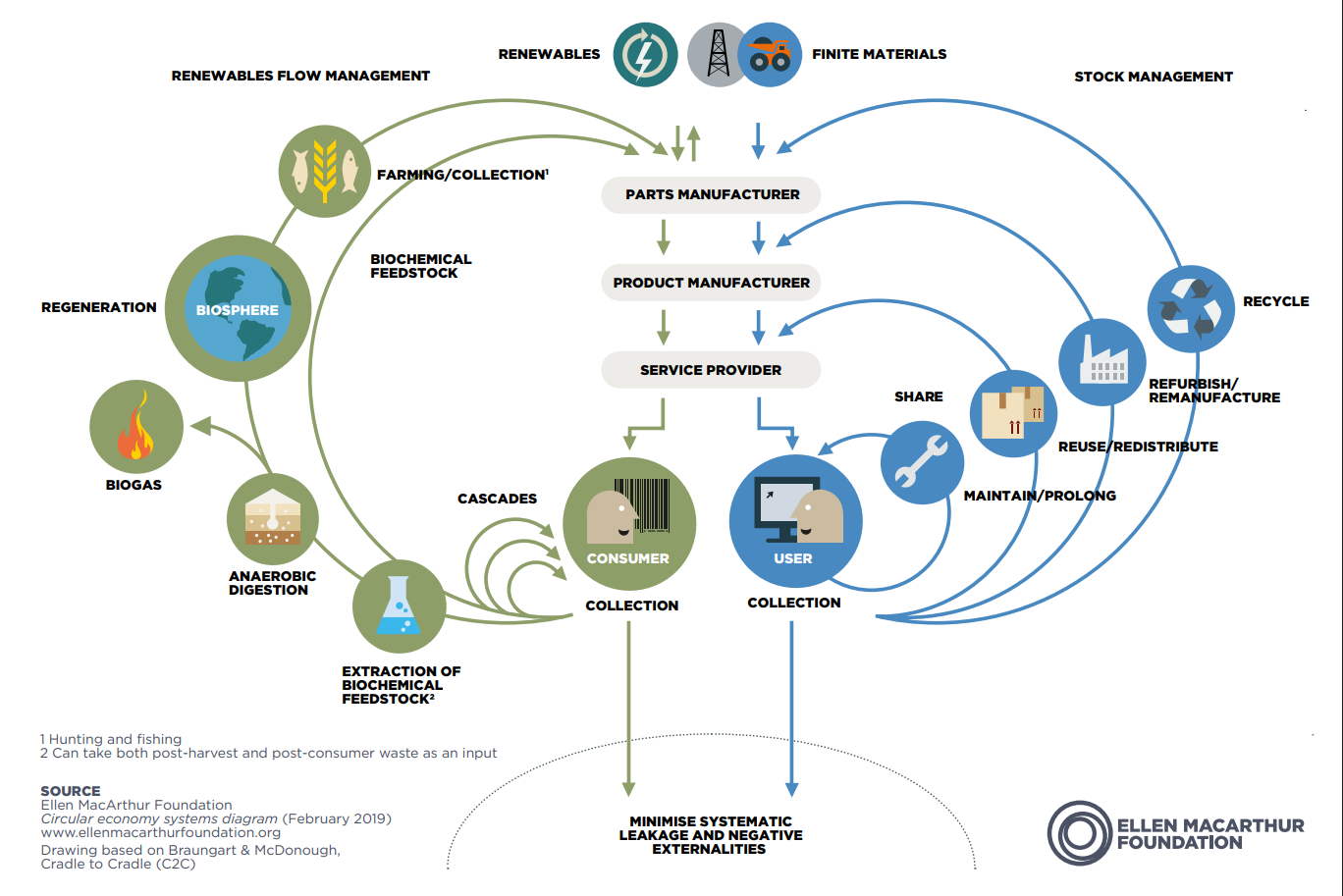
A regenerative design strategy inspired by natural ecosystems, where every output is intended to be reused in either biological (compostable) or technical (recyclable) systems. It encourages the perpetual cycling of resources, prioritizes renewable energy, non-toxic materials, and promotes ecosystem health and biodiversity.
-
A sustainable supply chain model where products and materials are continuously cycled through reuse, recycling, and remanufacturing processes. It focuses on reducing the need for new raw materials by designing goods for recovery and reintegration, with reverse logistics as a critical function. This reduces waste, conserves resources, and lowers operational costs.
-
A cooperative practice where different industries work together to repurpose by-products, excess energy, or materials from one business as resources for another. This interconnected system improves resource efficiency, lowers production costs, and decreases environmental footprints, fostering a more sustainable industrial ecosystem.
-
A business model that creates, delivers and captures value while reducing waste
Focus on reusing products and materials
Two main cycles: Biological & Technical (Butterfly Diagram)
Circular Business Models & Consumption
Shift from products to services
Promote sharing economy (e.g., tool libraries)
Extend product life: repairs, upgrades, education
Discover more on how companies can measure their circularity in CLAY unit2.3 - Lesson 2 - The principles of circularity measurement: https://rise.articulate.com/share/3TkCIDS9_SIsZH8bj_SpjoREFGo4YKWE#/lessons/snlmNL0-cTQEr7Fp_1cGseAK40SgqXM6
Sustainable Strategies for Circular Models
Rethink design and production
Shift to services and circular consumption
Foster industrial collaboration
Leverage technological innovation
2.2 What Does It Mean to Be Future-Oriented?
Being future-oriented means thinking about what’s ahead and making choices today that help you crush your goals tomorrow. It’s not just about dreaming big—it’s about planning smart and taking action now to create the future you want.
Clear Goals & Vision
Know what you want and picture your best future. Your goals are like a roadmap guiding your everyday moves.Planning Ahead
Instead of winging it, future-focused people think ahead, prepare for different possibilities, and stay flexible when things change.Thinking Long-Term
They don’t just go for quick wins. They’re ready to work hard now to get bigger, better rewards later.
Staying Open & Curious
Change is constant, so they stay curious, keep learning, and aren’t afraid to try new things or technologies.
Always Growing
They invest in themselves—learning new skills and gaining experiences so they’re ready for whatever comes next.
Optimism & Resilience
Even when things get tough, they believe progress is possible and bounce back stronger, always pushing forward.
In short, being future-oriented means taking control—turning your hopes into real steps today so your future is bright.
What Is Future-Oriented Sustainability?
Future-oriented sustainability means thinking beyond just fixing today’s environmental problems. It’s about creating long-lasting solutions that protect the planet and people for generations to come.
This way of thinking connects the dots between nature, society, and fairness across time. It challenges old ways of doing things and pushes for smart, ethical choices that keep the world healthy and just, now and in the future.
Hands-On Activity
Become a Young Eco-Entrepreneur
You are starting your own small green business in your local community! Your goal is to build a business that solves an environmental problem while also helping people and earning income.
-
Identify one real problem in your community or daily life related to the environment. Choose from:
Waste (e.g., plastic pollution, food waste)
Energy use (e.g., electricity overuse, lack of clean energy)
Water or air pollution
Fast fashion or throwaway culture
-
Think of a product, service, or campaign that solves the problem. Your idea should be:
Useful to your community
Sustainable (good for the planet)
Creative (think outside the box!)
You can sketch, build a small model using recycled materials, or create a visual poster to show your idea.
-
Answer these key questions about your green idea:
What does your business do?
Who will it help?
How does it protect the environment?
How will you explain your idea to customers?
-
Improve your idea using one or more of these circular economy ideas:
Can it be reused or refilled?
Can it be repaired instead of thrown away?
Can parts be recycled or made from recycled materials?
-
Can your idea include simple technology? Think of things like:
Solar power
A mobile app
A QR code for information
Sensors or tracking systems
-
Every business needs teamwork! Assign at least two roles in your group:
Eco Leader – keeps the project on track
Community Connector – explains the idea to others
Design or Tech Helper – builds the model or adds digital tools
Self-Assessment Quiz
In this unit, you explored:
A range of influential models and frameworks, including Regenerative Design, Industrial Ecology, Bio-based Economy, Green Economy, Performance Economy, Doughnut Economics, and *Cradle-to-Cradle.
Tools and strategies for building circular businesses, such as the *Circular Business Model Canvas*, Closed-Loop Supply Chains, and Industrial Symbiosis
The importance of a future-oriented mindset, with a focus on long-term thinking, adaptability, and continuous learning.
How future-oriented sustainability connects environmental responsibility with social equity and long-lasting economic value.
Key Takeaway:
Circularity is a vital strategy for reducing waste and reusing resources—but creating a truly sustainable future means thinking bigger. It requires a forward-thinking mindset that combines innovation, responsibility, and systems thinking for lasting impact.
-
BiomimicryInnovation inspired by nature’s designs and strategies, where solutions to human challenges are developed by learning from billions of years of natural evolution. It promotes creating products, systems, and businesses that work in harmony with the environment.
Source: https://www.ellenmacarthurfoundation.org/learn-from-nature
Cradle-to-CradleA design framework that encourages creating products with materials that can safely return to nature or be fully reused in new manufacturing cycles. It aims to eliminate harmful substances and supports sustainable, regenerative resource use throughout a product’s lifecycle.
Source: https://knowledge4policy.ec.europa.eu/glossary-item/cradle-cradle_en
Circular Business Model Canvas (Circular BMC)An adaptation of the traditional business model framework that integrates environmental and social sustainability. It helps organizations visualize how they create, deliver, and sustain value while aligning business operations with circular economy principles to reduce waste and impact.
Source: Osterwalder, Alexander; Pigneur, Yves; Clark, Tim (2010). Business Model Generation: A Handbook For Visionaries, Game Changers, and Challengers. Strategyzer series. Hoboken, NJ: John Wiley & Sons. ISBN 9780470876411. OCLC 648031756.
Industrial Symbiosis“Industrial symbiosis is the use by one company or sector of underutilised resources broadly defined (including waste, by-products, residues, energy, water, logistics, capacity, expertise, equipment and materials) from another, with the result of keeping resources in productive use for longer.
Further resources
Biomimicry Institute - What is Biomimicry: https://biomimicry.org/inspiration/what-is-biomimicry/
Osterwalder, Alexander; Pigneur, Yves; Clark, Tim (2010). Business Model Generation: A Handbook For Visionaries, Game Changers, and Challengers. Strategyzer series. Hoboken, NJ: John Wiley & Sons. ISBN 9780470876411. OCLC 648031756. .
Ellen McArthur Foundation - Circular Business Model Canvas : https://www.ellenmacarthurfoundation.org/articles/circular-business-models-rethinking-how-value-is-created
McDonough, William; Braungart, Michael (2002). Cradle to Cradle: Remaking the Way We Make Things. New York: North Point Press. ISBN 0865475873. OCLC 47623923
Lombardi, D. Rachel; Laybourn, Peter (February 2012). "Redefining Industrial Symbiosis". Journal of Industrial Ecology. 16 (1): 28–37. Bibcode:2012JInEc..16...28L. doi:10.1111/j.1530-9290.2011.00444.x. S2CID 55804558
Images (see format below)
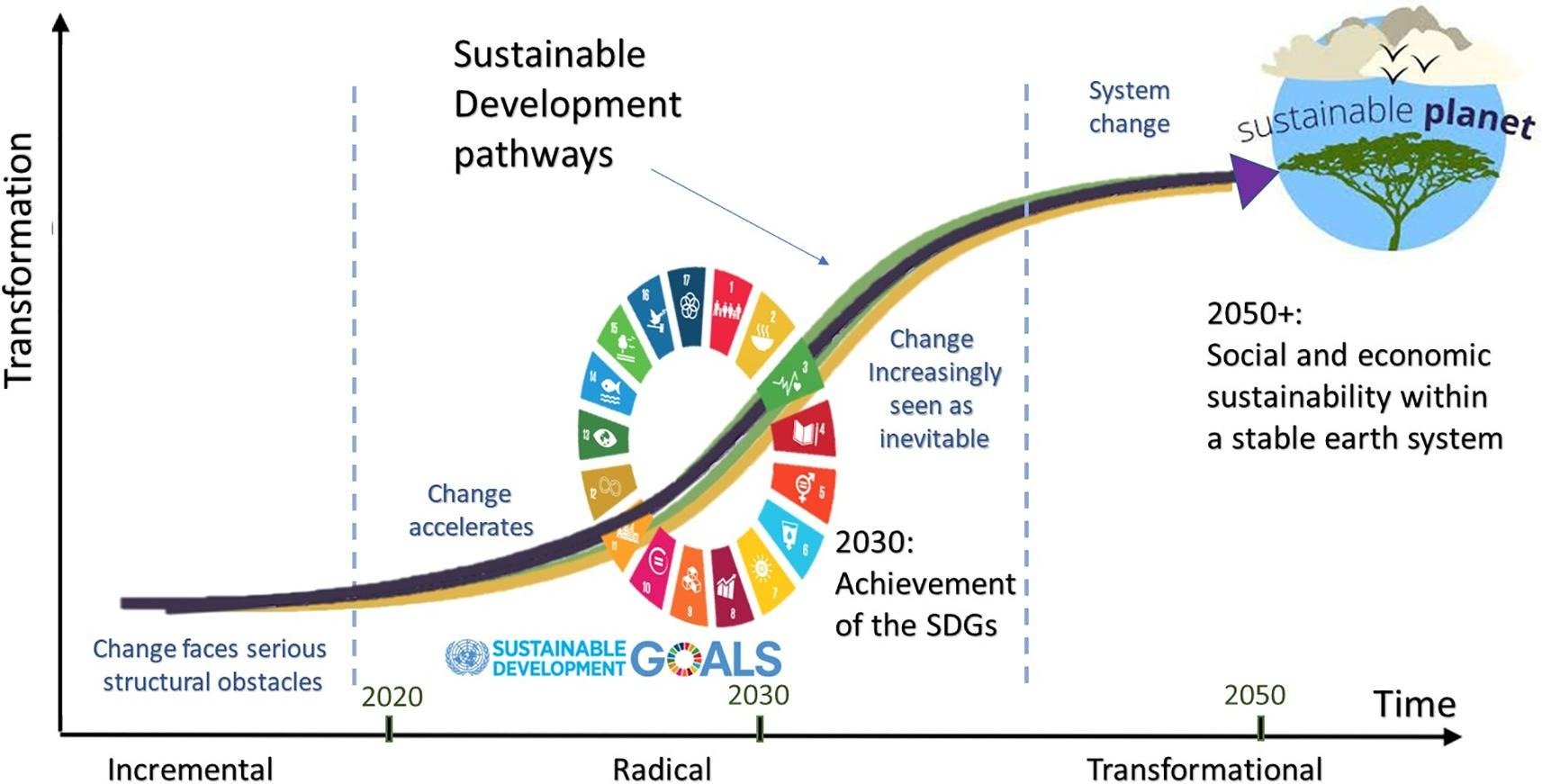
1- The transformational process for the transition to a sustainable world through the achievement of the SDGs (adapted from IIASA, 2018). https://www.sciencedirect.com/science/article/pii/S0959378022000826