
Module 2: Resources Management and Foundations of the Circular Economy
LEARNING OUTCOMES
-
2.1.K1.
Explain the differences between the linear and circular economy models -
2.1.S1.
Identify the 9Rs of circularity2.1.S.2
Differentiate between the 9Rs of circularity, and the effectiveness of each -
2.1.RA1.
Analyse how circular business models contribute to sustainability2.1.RA2.
Discuss the role of design in preventing waste and promoting circular economy
IN THIS LESSON, you will learn about the fundamental problems of our current economic system
UNIT 2.2 – Understanding Circular Economy
1. VIDEO
By ‘The Power Hub’ - this enlightening video breaks down the circular economy and its incredible potential to reshape our world! Discover the fundamentals, key principles, and inspiring examples of this sustainable economic model.
2. INTRODUCTION
In Unit 1 you learned and explored how your resource use has an impact on the environment and how your individual choices contribute to your carbon footprint. Now, in unit 2 we will shift the focus from individual actions to systemic change and look at how we can redesign the way we produce, consume & manage resources.
This unit introduces the concept of the Circular Economy, which is a powerful alternative to the traditional “Take, Make, Waste” model. In this unit you will learn what circular thinking is and how you can apply it in your personal life or in your community to create a long-lasting impact.
2.1 Linear Model Vs Circular Economy Model
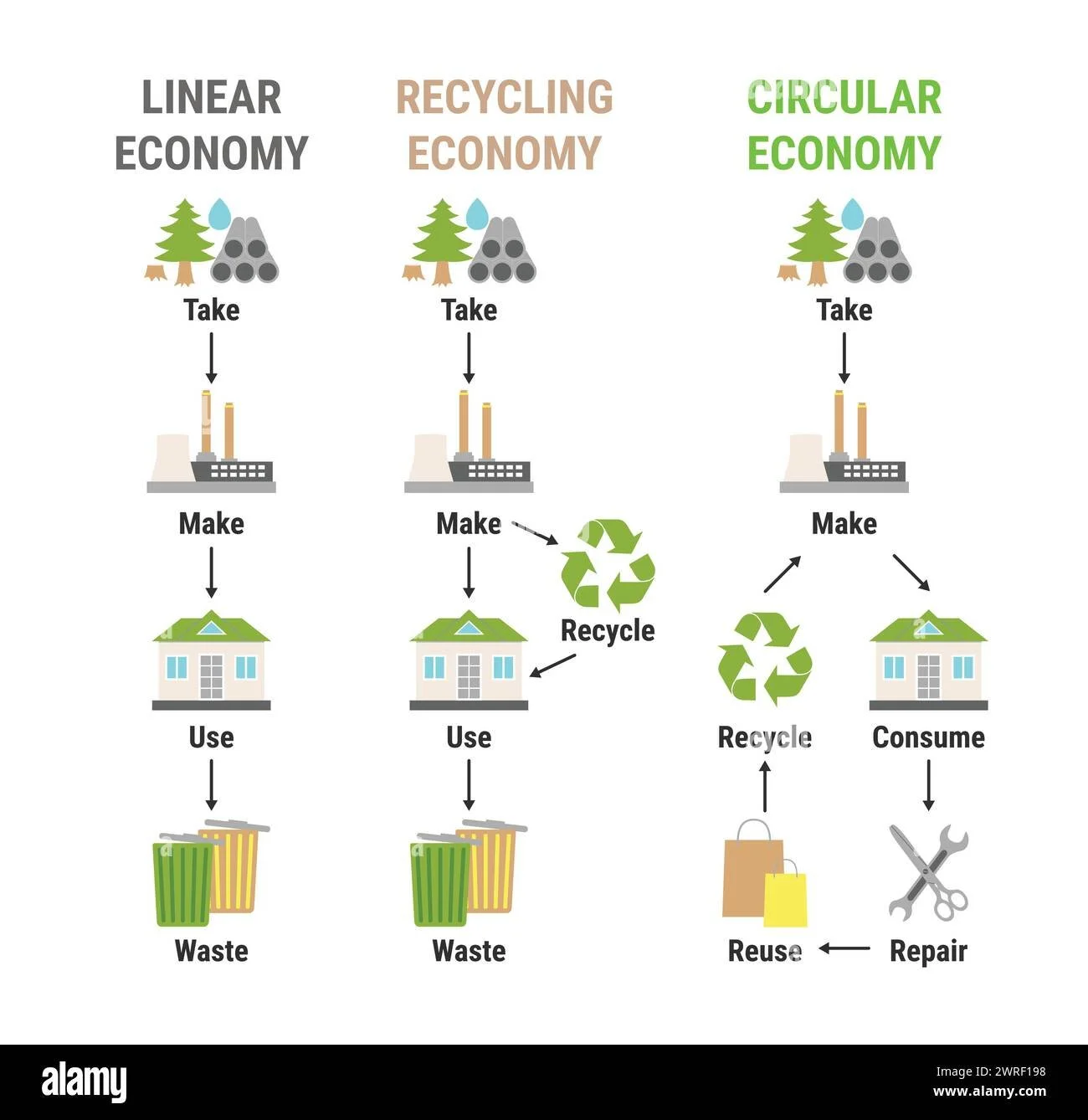
In a linear economy, we take materials from nature, make products, use them, and then throw them away. This creates a lot of waste and pollution. In a circular economy, we try to keep materials and products in use for as long as possible. Instead of throwing things away, we reuse, repair, or recycle them. The goal is to create less waste and use fewer new resources.
Linear Economy
Follows a straight path
Take -> Make -> Use -> Dispose
Take: Raw Materials are extracted
Make: Products are manufactured
Use: Consumers use the products
Dispose: Products are thrown away, often in landfill or incinerators
This model is resource intensive and wasteful, relying on constant extraction and disposal and it heavily contribute to pollution, climate change and resource depletion
Circular Economy
Designed to keep resources in use for as long as possible
Design -> Use -> Reuse -> Repair -> Recycle -> Regenerate -> Use -> Reuse -> Repair etc.
Designing out waste and pollution
Keeping products and materials in use
Regenerating natural systems
This model reduces environmental impact, saves money and resources, creates new jobs and builds resilience in communities and businesses.
The linear model harms the environment by using up natural resources and creating pollution. It can also be expensive when materials become harder to find. The circular model helps by saving resources, reducing pollution, and creating new jobs, like repair services or recycling businesses. It also helps companies design better products that last longer and are easier to fix.
For everyday people, the circular economy means more affordable and sustainable choices. Instead of buying everything new, people can share, rent, or fix things they already have. Communities benefit too; local sharing programs and repair shops help people save money and reduce waste. This way of living helps build stronger, fairer, and more eco-friendly communities.
“The greatest threat to our planet is the belief that someone else will save it.”
— Robert Swan (renowned British explorer and environmental activist)
Discover more on CLAY Unit 1.1 Linear vs Circular economy - Lesson 3 How is circular economy different?
2.2 What is The 9Rs Framework?
A Hierarchy of Circular Actions
The 9Rs Framework can be used as a tool for understanding how we can shift from a linear to a circular economy. It outlines the ranking of strategies that start with the most impactful that individuals and organizations can use to reduce resource use and eliminate waste.
-
Avoid products that generate waste or are unnecessary.
This is the first and most powerful step. Refusing means saying no to items that are harmful to the environment or not truly needed. For example, refusing plastic straws, single-use packaging, or promotional freebies that end up as clutter. It’s about conscious consumption and choosing not to participate in wasteful systems.
-
Challenge how products are designed and used. Rethinking involves questioning the status quo. Can a product be designed to last longer, be repaired, or shared? Can a service replace a product (e.g., streaming instead of buying DVDs)? This step encourages innovation and creativity in how we interact with goods and services.
-
Minimize resource use and consumption. Reducing means using less energy, less water, fewer materials. It’s about efficiency and simplicity. For example, turning off lights when not in use, printing double-sided, or choosing products with minimal packaging.
-
Use items multiple times instead of discarding them. Reusing extends the life of products. This could mean using glass jars for storage, donating clothes, or buying second-hand. It’s a way to keep materials in circulation and reduce demand for new resources.
-
Fix broken items to extend their life. Repairing is a practical and empowering step. Whether it’s sewing a torn shirt, fixing a leaky tap, or updating software on a device, repair prevents waste and saves money. It also supports local repair businesses and skills.
-
Restore used products to good condition. Refurbishing goes beyond simple repair. It involves cleaning, updating, and improving products so they can be used again. Common examples include refurbished electronics, furniture, or appliances.
-
Rebuild products using reused parts. Remanufacturing is a more industrial process where products are taken apart and rebuilt using a mix of old and new components. It’s common in sectors like automotive, machinery, and electronics.
-
Give items a new function or use. Repurposing is about creative reuse. It means taking something that’s no longer useful in its original form and turning it into something else. For example, using old tires as garden planters or turning worn-out clothes into cleaning rags.
-
Process materials to make new products. Recycling is the most well-known but least preferred option in the 9Rs hierarchy. It involves breaking down materials (like paper, plastic, or metal) and turning them into new products. While important, recycling still uses energy and often results in lower-quality materials.
The 9 R Framework gives individuals a chance to take action before they recycle, which is mistakenly seen as the first step. In the circular system, recycling should always be the last resort. Yes, it is valuable, but it is less effective than refusing or rethinking a product.
Circular Economy Advocate Kate Krebs believes “Waste is a design flaw.” This quote captures the essence of the 9Rs. In a circular economy, waste is not an avoidable outcome, it is a result of poor design. When products are designed and manufactured, they should be done so with their life cycle in mind. How is the product going to be made, used, maintained and reintroduced into the circularity system?
The 9Rs also align with the waste hierarchy promoted by the European Union and other sustainability frameworks, which prioritizes prevention and reuse over disposal.
By applying the 9Rs, learners can begin to see waste as a resource and design solutions that close the loop, whether that means refusing single-use plastics, repairing a broken appliance, or supporting businesses that remanufacture goods.
2.3 What are Circular Business Models?
Product As A Service & Sharing Economy
Circular business models are designed to keep products, components, and materials in use for as long as possible, aligning with the principles of the circular economy. Two of the most transformative models are Product-as-a-Service and the Sharing Economy.
Sharing Economy
The Sharing Economy enables people to share access to goods and services, often through digital platforms. This model reduces the need for individual ownership and maximizes the use of existing resources. Instead of everyone owning a car, for instance, people can use car-sharing services like Zipcar or GoCar.
The Sharing Economy helps build stronger communities and gives more people access to useful things. Instead of everyone owning their own car, tools, or office space, people can share these resources. This makes life more affordable and helps people who might not be able to buy these things on their own. For example, shared workspaces help small businesses save money, and car-sharing lets people get around without needing to own a car.
Thanks to apps and websites, sharing is now easier than ever. You can quickly find a spare room, a ride, or a tool nearby. These platforms help people use what they already have, instead of buying new things. But for sharing to really help the environment, these systems need to be fair, sustainable, and well-managed. When done right, the Sharing Economy helps reduce waste, lower pollution, and encourages people to work together instead of just consume.
Product-as-a-Service
In a Product-as-a-Service model, customers access a product without owning it. Instead of buying a washing machine, for example, a customer might pay a monthly fee to use one, while the manufacturer remains responsible for maintenance, upgrades, and eventual recycling. This model incentivizes companies to design durable, repairable, and efficient products, since they retain ownership and bear the cost of upkeep.
In a Product-as-a-Service model, customers don’t buy a product, they pay to use it. The company still owns the product, so they’re responsible for keeping it in good condition. This means they’re more likely to design products that last longer, are easy to fix, and can be upgraded over time. Unlike traditional business models that encourage people to replace things often, PaaS supports durability and quality.
This model also helps companies use data to improve their services. For example, they can track how a product is used and when it might need maintenance. This helps them fix problems early, improve future designs, and offer better customer support. You’ll see PaaS in things like bike-sharing, home appliances, and industrial machines. Instead of selling as many products as possible, companies focus on giving customers great service while also helping the environment.
Product as a service shifts the focus from selling more products to delivering better service. It supports sustainability by reducing overproduction, encouraging reuse, and minimizing waste.
Other examples include:
Tool libraries where communities share equipment.
Airbnb, which allows homeowners to rent out unused space.
Peer-to-peer clothing rental platforms that reduce fast fashion waste.
Both models challenge traditional consumption patterns and promote collaboration, efficiency, and sustainability.
Click here to discover more: CLAY unit 1.3 The transition towards circular economy - Lesson 4 - Circular consumption
-
Add a short summary or a list of helpful resources here.